Nonlinear Climate Dynamics and Anthropogenic Forcing
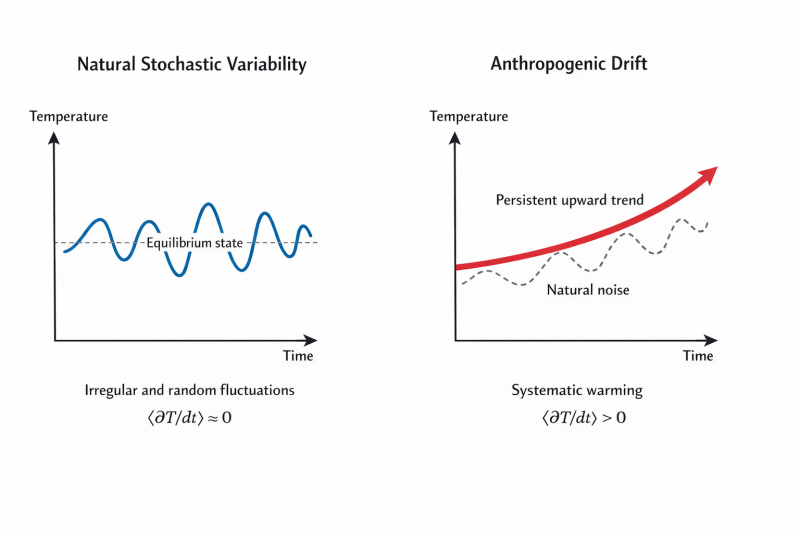
Describing the climate system dynamically as a nonlinear and stochastic system does not, by itself, explain what drives the observed long-term warming trend. What such a framework does accomplish, however, is to distinguish between two fundamentally different classes of phenomena: internal variability, which is largely zero-mean fluctuation around equilibrium, and external forcings, which can shift the equilibrium state of the entire system.
When the climate system is described in terms of energy balance, the key variable becomes radiative forcing. Natural factors—such as ENSO, PDO, volcanic activity, and the solar cycle—can be modeled as stochastic or quasi-periodic processes whose effects vary over time and whose average contribution over the long term is close to zero, or at least lacks any persistent monotonic trend. They can push temperatures up or down over years to decades, but they do not produce a continuous, cumulative imbalance in the energy budget without an external structural change.
Against this backdrop, anthropogenic forcing is fundamentally different in nature. The concentrations of CO₂ and other greenhouse gases do not behave as a stationary process; instead, they contain a long-term, cumulative component arising from the imbalance between emissions and sinks. This is directly reflected in radiative forcing, which increases logarithmically with CO₂ concentration and introduces a persistent positive energy imbalance into the system. In other words, a term is added to the system that does not average to zero, but instead integrates over time.
This is the essential distinction between stochastic variability and forced change. Natural climate dynamics can be described as a process in which temperature oscillates around equilibrium due to random and quasi-periodic perturbations. Anthropogenic influence, by contrast, shifts the equilibrium itself by introducing a sustained radiative imbalance that forces temperatures to rise as long as the forcing persists.
Observational data support this distinction: the current global warming trend is temporally consistent with the increase in radiative forcing derived from human activity, and no comparable long-term, monotonic temperature trend can be explained solely by known natural forcings or internal variability. Natural factors explain most short-term fluctuations, but not the observed multidecadal rise.
Thus, when the system is examined dynamically and stochastically within the correct physical framework, the key conclusion is not merely that climate varies, but that the current long-term warming requires a continuous external energy forcing as its explanation. In this sense, human influence is not just one modulating factor among others; it is the only known component that produces the observed persistent and cumulative change in the climate system’s energy balance.
Mathematical Appendix
1. General stochastic dynamics of the climate system
C dT/dt = F(t) − λT + η(t)
Or equivalently:
dT/dt = (1/C) [F(t) − λT + η(t)]
2. Decomposition of forcing into natural and anthropogenic components
F(t) = F_NAT(t) + F_ANTH(t)
3. Natural variability (zero-mean process)
F_NAT(t) = ∑ᵢ fᵢ(t), ⟨fᵢ(t)⟩ ≈ 0
And stochastic internal variability:
η(t), ⟨η(t)⟩ = 0
Combined:
⟨F_NAT(t) + η(t)⟩ ≈ 0
4. ENSO-type nonlinear equilibrium (natural state)
d²T/dt² − μ(1 − T²) dT/dt + ω²T = η(t)
5. Long-term stochastic equilibrium (natural state)
⟨T(t)⟩ ≈ constant ⇒ ⟨dT/dt⟩ ≈ 0 (in the absence of external trend)
6. Anthropogenic CO₂ dynamics
dC/dt = E(t) − κC
7. From CO₂ to radiative forcing
F_CO₂ = α ln(C / C₀)
8. Anthropogenic forcing (non-stationary component)
F_ANTH(t) ≠ stationary, d/dt ∫ F_ANTH(t) dt > 0
9. Near-complete climate model (combined structure)
C dT/dt = F_NAT(t) + F_ANTH(t) − λT + η(t)
10. Key structural distinction
Natural variability:
⟨F_NAT(t)⟩ ≈ 0 ⇒ ⟨T(t)⟩ does not drift
Anthropogenic forcing:
⟨F_ANTH(t)⟩ > 0 ⇒ ⟨T(t)⟩ increases over time
Luo oma verkkosivustosi palvelussa Webador